
Festive Season in Sri Lanka
From the glowing paper lanterns of Vesak to the thundering drums of the Esala Perahera, Sri Lanka doesn’t just celebrate — it transforms. Here is your guide to the island’s most extraordinary festive season, a remarkable, unbroken thread of cultural celebration that stretches from April all the way through to October.
Where It All Begins: Avurudu – April
Sri Lanka’s festive season opens with one of its most joyful chapters: Avurudu, the Sinhala and Tamil New Year, celebrated every April as the sun moves from Pisces into Aries. Known as Aluth Avurudu in Sinhala and Puthandu in Tamil, this is not simply a date on a calendar it is a full cultural and astrological new beginning, observed by communities across the entire island.
In the days leading up to Avurudu, homes are scrubbed clean and decorated. Kitchens fill with the aromas of kiribath (milk rice), kokis (crispy oil pastries), aluwa (sweet confections), and kavum (oil cakes) traditional sweets prepared specifically for the occasion. Every ritual takes place at a precise, auspicious time determined by the almanac: the lighting of the hearth, the partaking of the first meal, the departure from the home for the first time, and the first commercial transaction of the new year.
Outside, the streets come alive. Villages across the country hold Avurudu games kotta pora (pillow fights), kana mutti (pot breaking), banis kaema (bun-eating contests) filling neighbourhoods with laughter, colour, and the kind of warm communal spirit that is quintessentially Sri Lankan. For travellers, this is one of the most immersive cultural experiences the island offers. To witness Avurudu is to see Sri Lanka at its most open, generous, and joyful.
The Festival of Light: Vesak – May
If there is one festival that defines Sri Lanka’s spiritual identity to the outside world, it is Vesak Poya in May. Commemorating the birth, enlightenment, and passing into Nibbana of Lord Buddha, Vesak is both a day of deep religious reflection and a breathtaking visual spectacle.
As dusk falls over Colombo and Kandy, the cities undergo a complete transformation. Tens of thousands of hand-crafted Vesak lanterns, intricate paper creations in every conceivable shape and colour are strung along streets and suspended from buildings. Towering Thoranas (illuminated pandols), some reaching several storeys high and constructed over weeks by community groups, line the main roads, depicting scenes from the Jataka stories and the past lives of the Buddha in vivid, backlit paintings.
The atmosphere is unlike anything else in the world. There are no entrance fees, no tickets, no velvet ropes. The celebrations belong entirely to the people. Dansals free food and drink stalls set up by families, businesses, and community groups line the streets, offering meals, tea, and refreshments to every passer-by, regardless of faith or background. To walk through a Sri Lankan city during Vesak night is to move through a glowing, generous, sacred world.
Arrival of the Dhamma: Poson – June
June brings Poson Poya, one of Sri Lanka’s most spiritually significant commemorations. It marks the arrival of Buddhism to the island over 2,300 years ago, carried by Arahat Mahinda, son of the great Indian emperor Ashoka, who brought the teachings of the Buddha to the Sinhalese king Devanampiya Tissa.
The sacred city of Mihintale, the very hill where Mahinda first met the king, became the heart of the nation’s celebrations. Thousands of white-clad pilgrims make the climb barefoot up the ancient stone steps to the summit, while temples island-wide glow with oil lamps and white pennants. Dansals once again appear along roadsides, and an atmosphere of extraordinary generosity and quiet reflection settles over the country.
Where Vesak is radiant and festive, Poson carries a quieter, more contemplative energy. It is deeply moving in a different way a reminder of how profoundly Buddhism has shaped every aspect of Sri Lankan life, from its architecture to its ethics, its festivals to its food.
For travellers, June also brings a wonderful secondary gift: the Cultural Triangle Anuradhapura, Polonnaruwa, Sigiriya becomes serenely uncrowded. The ancient stone cities, which can feel overwhelmingly busy in peak season, are suddenly peaceful and intimate, accessible in near-total solitude.
The Build-Up: Esala – July
July in Sri Lanka is a month of gathering anticipation. In the hill capital of Kandy, the city begins its weeks-long preparation for what is arguably Asia’s greatest cultural spectacle: the Kandy Esala Perahera. Temple rituals commence, drummers rehearse in courtyards, and the city hums with a sense of occasion that builds night by night.
The Grand Spectacle: Esala Perahera & Nallur – August
August is, without question, Sri Lanka’s most culturally spectacular month.
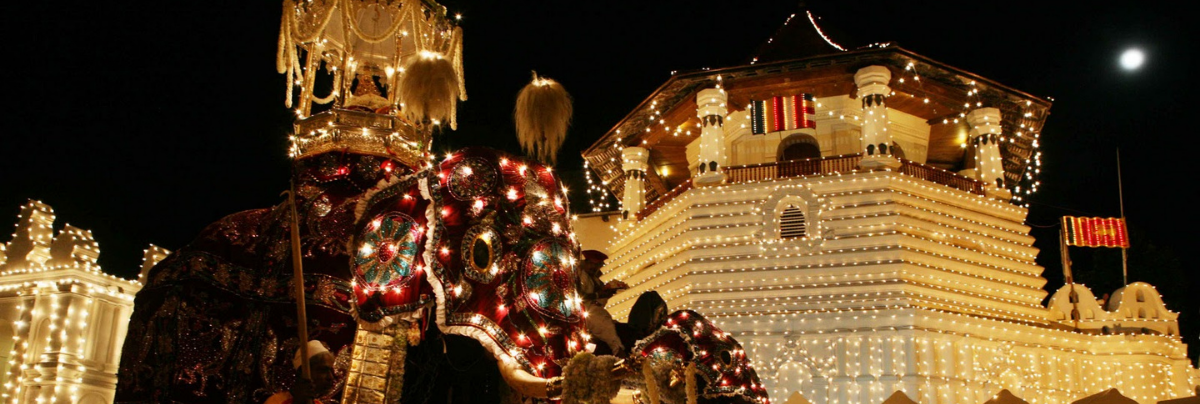
The Kandy Esala Perahera reaches its magnificent climax over ten consecutive nights. This is one of Asia’s oldest and grandest living pageants a nightly procession through the streets of Kandy that has been performed for over three centuries in honour of the Sacred Tooth Relic of the Buddha, Sri Lanka’s most revered treasure.
To witness the Perahera is to experience something genuinely overwhelming. Dozens of magnificently adorned elephants draped in embroidered cloth and lit by electric lamps process through the streets alongside hundreds of Kandyan drummers, whose rhythms fill the city with a sound that seems to resonate in the chest. Fire dancers and whip crackers perform in flickering torchlight, while Ves dancers elaborately costumed in traditional headdresses that take years of training to earn the right to wear represent the island’s living classical heritage. The entire procession can stretch for several kilometres and last for hours.
At the same time, in the northern city of Jaffna, the Nallur Kandaiah Festival reaches its own extraordinary crescendo at the historic Nallur Kandaswamy Temple, one of the most important Hindu temples in South Asia. Spanning nearly a month in total, the festival fills Jaffna with colour, traditional music, acts of deep devotion, and an atmosphere of spiritual intensity that is unlike anything else on the island. These are two of Sri Lanka’s greatest cultural events unfolding simultaneously a reminder of just how rich and layered this island’s traditions truly are.
The Sacred South: Kataragama – September
As August gives way to September, the spiritual energy of the island shifts southward to the sacred city of Kataragama, one of Sri Lanka’s most fascinating and mysterious places of worship.
The Kataragama Esala Festival is a rare and remarkable thing: a multi-faith celebration that brings together Buddhist, Hindu, Muslim, and indigenous Vedda traditions in a single shared space of devotion. Pilgrims travel from across the island and from around the region to honour God Kataragama, undertaking extraordinary acts of faith fire-walking, body piercings, and long ritual processions that speak to the depth and sincerity of their devotion.
The atmosphere in Kataragama during festival season is intense, deeply spiritual, and profoundly moving. This is not a performance for tourists, it is a living, breathing expression of faith that has continued uninterrupted for centuries.
The Festival of Lights: Deepavali – October
October brings the festive season to its poetic close with Deepavali, the Hindu festival of lights, celebrated with great warmth and beauty by Tamil communities across the island.
Homes are illuminated with rows of clay oil lamps tiny flames that symbolise the triumph of light over darkness and good over evil. Families gather for prayer, new clothes are worn, sweets are prepared and shared with neighbours, and temples come alive with colour, music, and devotion. In Jaffna and across the Hill Country tea estates, the sight of thousands of oil lamps flickering against mist and darkness is one of the most quietly beautiful images Sri Lanka offers.
It is, for those who find it, one of the most intimate and beautiful times to experience Sri Lanka.